
For facilities that handle towels, sheets, uniforms, gowns, robes, mop heads, or resident linens every day, laundry can become one of the most frustrating operating expenses. That is why many high-volume businesses ask a practical question: can on-premise laundry reduce costs without creating more work for the team?
In many cases, the answer depends on volume, layout, utilities, labor flow, and the real cost of the current process. However, a practical OPL cost breakdown often shows that savings do not come from one line item. Instead, the value comes from reducing repeated service charges, improving turnaround time, lowering linen replacement costs, and using programmable commercial laundry equipment more efficiently.
For hotels, gyms, salons, spas, healthcare facilities, fire departments, correctional facilities, and senior living communities, on-premise laundry is an operational system. When that system is designed correctly, it gives the business more control over daily output, service quality, and long-term cost planning. Southeastern Laundry Equipment works with organizations that need reliable OPL equipment, efficient layouts, and practical support.

On-premise laundry reduces costs when daily laundry volume is high enough to support a dedicated system. At first, outsourced laundry may look simple because it turns a daily task into a recurring invoice. However, that invoice may include pickup, delivery, fuel, administrative fees, minimum service levels, rush charges, replacement fees, and contract adjustments.
As a result, the true cost can grow as the business gets busier. A hotel with higher occupancy, a fitness center adding members, or a senior care facility expanding beds may all produce more linen volume than expected. Because of that, costs can rise just when the operation needs more flexibility.
An OPL system changes the equation. Instead of paying repeatedly for outside processing, the business manages laundry inside the facility with equipment sized for its workload. With that visibility, leaders can compare machine capacity, labor hours, utilities, detergent usage, maintenance, and linen life against their current expense. Just as important, an on-premise setup helps reduce hidden costs such as shortages, emergency stock purchases, and service delays.
Outsourced laundry charges can feel predictable at first. Yet, over time, the total cost may become harder to control. The facility is often paying for the provider’s labor, transportation, route scheduling, equipment, utilities, overhead, and profit margin. As a result, your laundry expense may include costs that do not directly improve your operation.
For example, a gym may run short during peak hours, a salon may lose time sorting returned towels, and a hotel may carry extra par levels because clean linen is not always back when housekeeping needs it.
That is why decision-makers should look at total laundry cost, not just the weekly service charge.
| Cost Factor | Outsourced Laundry Model | On-Premise Laundry Model | Why It Matters |
|---|---|---|---|
| Processing cost | Charged by pound, item, bag, or contract | Managed through equipment, utilities, labor, and supplies | High volume may favor internal processing |
| Turnaround time | Depends on pickup, route, plant capacity, and delivery | Can be same day when capacity is planned well | Faster cycles reduce linen shortages |
| Linen inventory | Often requires higher par levels | Can operate with tighter inventory control | Fewer backup linens may reduce stock expenses |
| Replacement costs | Loss, damage, and mix-ups can be harder to trace | Handling stays inside the facility | Better control may extend linen life |
| Utility use | Included in outside service pricing | Visible and manageable on site | Efficient machines and off-peak timing improve planning |
| Service disruption | Weather, route delays, or vendor issues can affect supply | Equipment uptime and maintenance become key planning areas | Planned maintenance helps protect daily output |
This comparison shows why a simple “price per pound” calculation can miss the point. Two facilities with the same volume may reach different conclusions if one has better space, utilities, and workflow.
Want to see what OPL could save your facility?
Southeastern Laundry Equipment can help you compare current laundry expenses, linen volume, utilities, workflow, and equipment needs before you make a decision.
Request an OPL Cost ReviewHigh-volume laundry changes the math because fixed costs are spread across more pounds, loads, or pieces. For a small business that washes only a few loads per week, a dedicated OPL setup may not create enough savings. However, once laundry becomes a daily need, the financial picture can shift.
Hotels, assisted living communities, medical offices, athletic departments, spas, and salons often have predictable laundry patterns. That allows them to build a system around real use, schedule loads throughout the day, and reduce the need for large emergency linen reserves.
In addition, OPL equipment is built for commercial use. Properly sized commercial washers and dryers can handle larger loads, steady throughput, and frequent operation. Because of that, the facility can process more laundry with fewer bottlenecks when the system is planned correctly.
Programmable washers and dryers can improve laundry cost savings because they reduce guesswork. Instead of relying on every staff member to choose the right cycle each time, facilities can use preset formulas for specific items.
For example, towels may need a different cycle than sheets, and healthcare linens may need more careful handling than standard guest laundry. With programmable controls, the team can keep the process more consistent.
That consistency matters financially. First, it helps prevent over-washing, which can waste water, energy, chemicals, and labor time. Next, it can reduce under-washing, which may lead to rewash cycles. Finally, it can help protect linen quality by matching wash action, temperature, and cycle length to the textile.
Efficient OPL planning also looks at dryer performance. Overdrying can shorten linen life and increase energy use, while underdrying slows folding, storage, and room turnover. In turn, programmable drying cycles can help the laundry room run with fewer delays.
For broader efficiency context, facility teams can review the ENERGY STAR commercial clothes washer guidance and the U.S. Department of Energy commercial clothes washer standards. ENERGY STAR notes that certified commercial clothes washers use less water and energy than standard models, while the Department of Energy provides federal standards and test procedure information for commercial clothes washers.
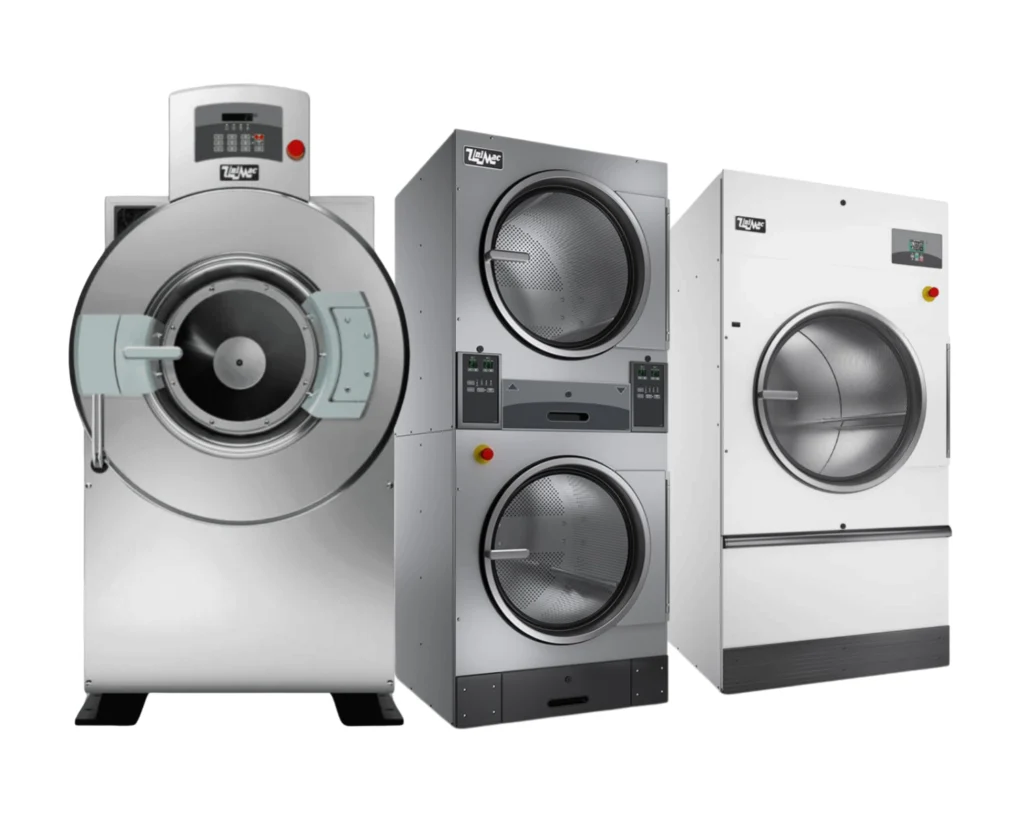
Utility costs matter in every laundry room. However, they matter even more in high-volume operations because small improvements repeat hundreds or thousands of times per year. Because of that, an on-premise laundry cost breakdown should include water, sewer, gas, electricity, and ventilation needs.
Modern OPL equipment can support better utility control in several ways. For instance, programmable cycles can reduce unnecessary hot water use, while high-extract washers can remove more water before drying. In addition, correct load sizing can prevent staff from running half-empty machines during busy shifts.
Off-peak operation can also help in some facilities. If utility rates or operational schedules make it practical, teams may run certain loads during lower-demand hours. As a result, clean linens can be ready before the morning rush, housekeeping shift, opening appointments, or resident care routines begin.
Still, utility savings should be planned, not guessed. A laundry expert can evaluate utilities, space, drainage, ventilation, and workflow before recommending equipment. That step matters because the most efficient machine on paper may not be the best fit if the room cannot support it properly.
Laundry cost is not only about machines and utility bills. Linens, towels, gowns, robes, and uniforms are assets. When they disappear, come back damaged, or wear out too quickly, the business pays again.
On-premise laundry gives facilities a better way to track those assets. Because items stay inside the building, managers can usually identify where loss or damage occurs more quickly. In addition, staff can separate textiles by use, soil level, or fabric type instead of sending everything through a general process.
This control can protect guest experience as well as budget. Fresh sheets, clean towels, well-kept robes, and dependable care linens all affect confidence. For that reason, linen replacement cost should be part of every OPL return-on-investment conversation.
Labor can either support OPL savings or weaken them. That is why the laundry room should be planned around the way people actually work, not just where the equipment fits. A layout may look fine on paper, but if staff have to carry wet laundry across the room, sort clean linens near soiled items, or wait for dryers to catch up with washers, those small delays can add up across every shift.
For example, a hotel may have enough washer capacity but still struggle with room turnover because clean sheets sit unfolded during peak housekeeping hours. A fitness center may have towels washed quickly, but if the clean towel storage area is too far from the front desk or locker rooms, employees lose time restocking throughout the day. In a senior living facility, laundry flow can affect care routines, especially when resident linens, towels, and garments need to be returned to the right place without confusion.
A practical OPL workflow should look at the full path of laundry from collection to sorting, washing, drying, folding, storage, and redistribution. Once that path is clear, equipment placement and staff routines can be built around it. Training also matters. Staff should know which cycles to use, how full each machine should be, how to report service issues, and how to avoid overloading equipment. When the process is simple and repeatable, the laundry room is less likely to become a daily bottleneck.
Southeastern Laundry Equipment supports OPL planning, equipment selection, installation, and service guidance for facilities that want a laundry room built around real operational needs. The goal is not to make laundry more complicated. It is to help the process become more predictable, efficient, and manageable as volume changes.
Is your laundry room working against your team?
A practical OPL layout review can help your facility plan around real laundry flow, staff movement, utility access, and daily turnaround needs.
Talk With an OPL Laundry ExpertAlthough on-premise laundry reduces costs for many high-volume operations, it is not automatically the right move for every facility. The strongest decision is the one based on real numbers, available space, staffing, utilities, and daily demand. A small office that only washes a few loads per week will have a very different calculation than a hotel, salon, spa, gym, or care facility handling laundry every day.
OPL may be harder to justify when laundry volume is very low or when the building does not have the right space for equipment, drainage, ventilation, and safe linen movement. Staffing should also be part of the review. If a team is already stretched thin, adding laundry responsibilities without a clear workflow can create frustration instead of savings. In that case, the issue may not be the equipment itself, but the lack of planning around how the laundry room will be used.
These challenges do not always rule out OPL. Sometimes the better answer is a smaller system, a phased equipment plan, a revised room layout, or a different laundry schedule. For instance, a salon may not need a large setup, but it may benefit from equipment sized for steady towel turnover during busy appointment days. A senior living community may need a more structured process to keep resident items organized. A site evaluation can help identify those details before the facility commits to a setup that is too large, too small, or poorly matched to the building.
A useful OPL cost breakdown starts with the facility’s current laundry reality, not a generic estimate. Gather several months of outsourced laundry invoices, linen replacement purchases, delivery notes, rush charges, and any staff time tied to sorting, checking, storing, or tracking laundry. This gives decision-makers a clearer view of what the current process really costs beyond the weekly service charge.
Next, compare those numbers with projected on-premise laundry costs. That review should include average laundry volume, equipment capacity, utility access, detergent and chemical use, labor hours, maintenance planning, linen inventory, and available storage space. It should also account for operational issues that may not show up neatly on an invoice. For example, a hotel may lose time when clean linen is not available for room turnover. A spa may need more robes than expected because laundry turnaround is slow. A gym may have to keep buying extra towels because peak-hour demand outpaces delivery schedules.
The most helpful cost breakdown connects financial numbers to daily operations. It should answer practical questions such as how much laundry the facility produces, how quickly clean items need to return to service, how much backup linen is currently required, and whether existing utilities can support the right equipment. Once those details are clear, it becomes much easier to see whether OPL will create meaningful savings, smoother turnaround, or better control over linen quality.
For that reason, the right OPL plan should measure both cost and operational impact. The goal is not just to compare one expense against another. It is to understand whether an on-premise laundry system can help the facility run with fewer delays, fewer shortages, and better long-term control.
Choosing an OPL setup is not only about selecting machines. It is about designing a laundry process that can support the facility every day, from workflow and utilities to training and service.
Southeastern Laundry Equipment provides commercial laundry equipment and OPL support for businesses across the Southeast and Texas. The team works with high-laundry environments that need dependable daily performance.
Because every facility is different, the best starting point is a conversation about numbers: volume, turnaround needs, available space, utilities, and current pain points.
Once those questions are clear, it becomes easier to decide whether OPL is worth it. More importantly, it becomes easier to design a laundry room that supports long-term savings instead of creating new headaches.
Ready to review the right OPL setup for your location?
Connect with a Southeastern Laundry representative who can review your facility type, laundry volume, turnaround goals, and equipment planning needs.
Find Your Local Southeastern Representative
On-premise laundry reduces costs when volume, equipment, labor, utilities, and workflow are aligned. For high-laundry businesses, the savings may come from lower recurring processing expenses, fewer linen shortages, better textile control, smarter utility use, and faster turnaround.
However, the best OPL decision is never based on a single promise. It should be based on a practical cost breakdown and a clear view of how laundry affects the facility every day. When the numbers support it, an on-premise laundry system can give businesses more control, better consistency, and a stronger path to long-term cost management.
Not sure whether OPL makes financial sense for your facility? Talk with a commercial laundry expert before you invest.
Yes, on-premise laundry reduces costs for many high-volume facilities when the system is properly sized and the laundry room is planned around real daily use. The biggest savings often come from reducing recurring outsourced laundry charges, lowering linen replacement needs, improving turnaround time, and gaining better control over utilities, labor, and workflow.
On-premise laundry can reduce expenses by keeping washing, drying, and linen handling inside the facility. This gives managers more visibility into machine use, detergent use, staff time, linen loss, and turnaround speed. Instead of waiting for pickup and delivery, the business can process laundry as needed, which may reduce shortages and extra linen inventory.
OPL equipment is usually most practical for businesses that create laundry every day. Hotels, gyms, salons, spas, healthcare facilities, senior living communities, athletic facilities, and fire departments often benefit because they rely on clean towels, sheets, uniforms, gowns, robes, or linens to keep operations moving.
On-premise laundry makes the most financial sense when laundry volume is consistent, turnaround time matters, and the facility has enough space, utilities, and staffing to support the process. A small business with only a few loads per week may not see the same return as a facility that handles laundry throughout the day.
Facilities should compare current laundry invoices, pickup and delivery fees, linen replacement costs, rush charges, utility use, labor needs, detergent costs, maintenance planning, and available space. Looking only at one invoice rarely gives the full picture. A practical cost review should show how laundry affects both the budget and daily operations.
Programmable commercial washers and dryers can help lower OPL costs by making wash and dry cycles more consistent. Preset cycles can reduce over-washing, under-washing, excess water use, unnecessary heat, and rewash loads. Over time, that consistency may also help protect linens from avoidable wear.
Southeastern Laundry Equipment can help facilities review laundry volume, space, utilities, workflow, equipment needs, and service planning before making a decision. This helps businesses understand whether on-premise laundry reduces costs for their specific operation, rather than relying on a general estimate.
No. On-premise laundry is not always the right fit for every facility. If laundry volume is very low, space is limited, utilities need major upgrades, or staffing is not available, the numbers may not support an OPL system. That is why a site-specific cost breakdown is important before moving forward.