
Is community laundry profitable? On paper, it looks simple. Install machines. Set pricing. Collect revenue. Many apartment owners assume it’s an automatic income stream.
In reality, profitability depends on far more than installing equipment. It comes down to occupancy trends, utility efficiency, service reliability, and long-term planning. When those pieces align, a community laundry room can become a dependable asset. When they don’t, returns shrink quickly.
This guide breaks down the real numbers behind community laundry ROI so you can evaluate the opportunity with clarity instead of assumptions.
Before choosing equipment or designing a layout, you need clarity. Profitability begins with a detailed cost analysis. Without it, even a high-demand property can underperform.
Let’s walk through the key financial components.
Initial investment plays a major role in determining whether community laundry is profitable for your building. Fortunately, you can structure this investment strategically.
You can either buy machines outright or lease them. Both models can work. What matters most is long-term cost control and reliable service support.
Leasing often lowers upfront costs and typically includes maintenance. Purchasing gives you ownership and scheduling flexibility. Therefore, your decision should align with cash flow, capital strategy, and operational capacity.
Working with a service-focused partner like Southeastern Laundry Equipment ensures you evaluate both options realistically rather than emotionally.
Before installation, review your building’s infrastructure carefully. Electrical capacity, gas line access, plumbing, drainage, and ventilation all need to support commercial-grade equipment. In some properties, upgrades are minimal. In others, panel expansions or vent rerouting may be necessary. While these adjustments increase upfront investment, they also protect long-term performance and safety.
Local building codes and safety regulations must be followed carefully. Many jurisdictions follow standards published by the International Code Council (ICC building codes), which include ventilation and fire safety requirements for commercial dryers.
While permitting fees may feel minor, they should still be included in your capital planning.
Even if the upfront investment looks manageable, long-term expenses ultimately determine the true return on investment. The key is understanding how these costs behave over time.
Utilities are typically the largest recurring expense. Water, gas, and electricity can add up quickly, especially in larger properties. According to data from the U.S. Energy Information Administration, electricity alone represents a significant share of operational expenses in residential buildings. The good news is that modern commercial machines are designed for efficiency. High-speed extraction washers remove more moisture before drying, which reduces gas and electric usage. Over the course of a year, that efficiency can meaningfully improve margins.
Maintenance is the next variable. Whether you lease or own your equipment, machines will require servicing. A belt will wear out. A valve will stick. A sensor will need recalibration. The difference between profitability and frustration often comes down to response time. In one 48-unit property we evaluated, a single out-of-service washer reduced weekly revenue by nearly 8 percent until repairs were completed. That kind of downtime adds up quickly. Proactive service scheduling keeps revenue steady and resident complaints low.
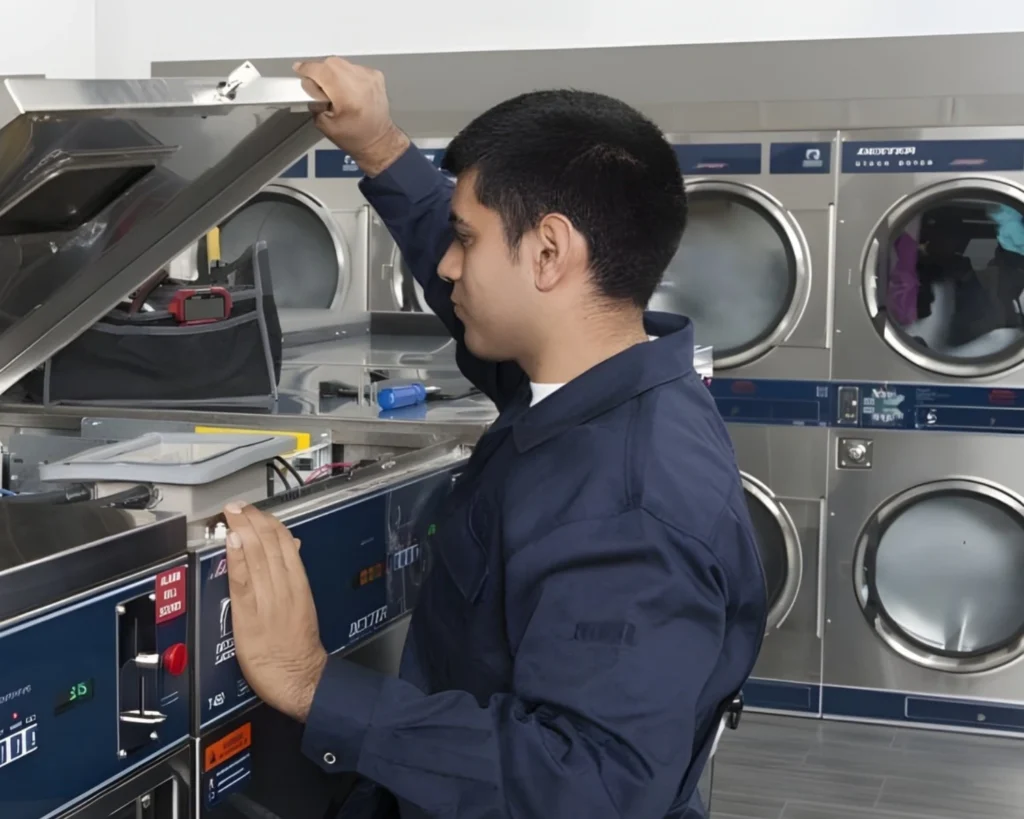
Insurance and risk management also deserve attention. Laundry rooms combine water lines, heat sources, and electrical systems. While premiums typically don’t spike dramatically, it’s wise to confirm coverage details with your carrier before installation. Taking a few preventative measures, such as proper drainage and routine lint removal, reduces both risk and long-term liability.
Finally, cleaning and oversight matter more than most owners expect. A laundry room that feels neglected discourages usage and damages perception. On the other hand, a clean, well-lit space reinforces professionalism and encourages residents to rely on the amenity consistently. That consistency is what turns a functional room into a stable revenue source.
Now we reach the most important question: apartment laundry profitability in real-world numbers?
Let’s examine how to calculate it properly.
Start by identifying three core variables: the total number of units in the building, your average occupancy rate, and the estimated number of loads each household completes per week. These inputs form the foundation of any realistic revenue projection.
For example:
| Variable | Example Scenario |
|---|---|
| Units | 60 |
| Occupancy | 95% |
| Avg. loads per unit/week | 3 |
| Weekly washer cycles | 171 |
60 units × 95% occupancy × 3 loads = 171 cycles per week
If each wash costs $2.50, weekly washer revenue equals:
171 × $2.50 = $427.50
Dryer revenue would be similar or slightly higher depending on pricing.
$427.50 per week × 4.33 weeks (the annual average of 52 weeks divided by 12 months) = approximately $1,852 per month (washers only)
Add dryers, and monthly revenue could reach approximately $3,200–$3,600 depending on pricing.
Assume:
Total expenses: $1,400
If gross revenue is $3,400, estimated net monthly income becomes $2,000.
That equals $24,000 annually before taxes.
In this scenario, the numbers clearly support the investment.
If you’re still asking, “is community laundry profitable?” it helps to look beyond simple monthly estimates. Long-term ROI modeling gives you a clearer picture of five-year and ten-year returns.
Let’s expand the earlier example.
Assume:
Your simple payback period would be:
$65,000 ÷ $24,000 = 2.7 years
After that point, the laundry room generates positive cash flow.
Now extend that projection:
| Year | Net Income | Cumulative Net |
|---|---|---|
| 1 | $24,000 | $24,000 |
| 2 | $24,000 | $48,000 |
| 3 | $24,000 | $72,000 |
| 5 | $24,000 | $120,000 |
| 10 | $24,000 | $240,000 |
Even after maintenance increases or moderate utility inflation, the long-term value remains strong.
Therefore, when evaluating whether community laundry is profitable, always consider long-term asset performance — not just first-year numbers.
If your laundry generates $24,000 annually and your property trades at a 6% cap rate, the added value could be calculated as:
$24,000 ÷ 0.06 = $400,000 in potential added property value.
While cap rates vary by market and asset class, this example illustrates how additional Net Operating Income (NOI) from a community laundry room can influence overall valuation when recognized in financial reporting.
Curious what the numbers look like for your property?
A quick ROI evaluation can help you estimate projected revenue, operating costs, and realistic payback timelines based on your unit count and occupancy.
Request a Laundry ROI ReviewModern commercial systems now support app-based payments, credit and debit transactions, and detailed usage tracking. Some platforms even offer remote monitoring, allowing owners or managers to review performance data without being onsite. These tools don’t just add convenience for residents. They tighten operational control and reduce revenue leakage.

Cashless systems reduce coin collection labor, improve reporting accuracy, and minimize theft risk. As a result, revenue leakage drops.
When evaluating if community laundry is profitable, operational efficiency matters just as much as pricing per load.
Additionally, usage analytics help identify peak demand times and underperforming machines. That data supports smarter pricing and machine allocation decisions.
Utility costs often determine profit margins. However, efficiency strategies can significantly improve performance.
High-speed extraction washers reduce dryer runtime. Meanwhile, moisture sensors prevent overdrying. Together, these features reduce gas and electric usage.
Furthermore, regular maintenance keeps water valves and heating elements operating at peak efficiency. Small inefficiencies, if ignored, compound into larger expenses over time.
Partnering with a service-oriented laundry provider ensures machines stay calibrated and optimized, protecting your margins year after year.
One overlooked factor in long-term laundry room performance is risk management.
Revenue stability depends on several operational habits: quick repair turnaround, preventive service scheduling, clear resident usage policies, and consistent machine uptime. When even one of these breaks down, the financial impact shows up quickly. Maintaining discipline in these areas protects long-term apartment laundry profitability.
Even one out-of-service washer in a smaller property can reduce monthly revenue noticeably. Therefore, service responsiveness directly impacts financial performance.
This is where working with a regional service partner becomes important. Instead of waiting days for support, rapid local response helps protect cash flow.
Property owners regularly weigh capital improvements against each other. A fitness center may enhance marketing appeal. A pool can attract certain demographics. A renovated clubhouse may elevate first impressions during tours.
The difference is that most of those upgrades do not generate direct income. They support rent growth indirectly.
A community laundry room, by contrast, produces measurable revenue while still improving the resident experience. It functions as both an operational asset and an amenity. When evaluated alongside other improvement options, laundry often strikes a balance between return and practicality.
This broader comparison is important. The question is not simply “is community laundry profitable,” but whether it delivers a stronger return relative to other uses of capital.
Commercial washers and dryers typically last 10–15 years depending on usage and maintenance.
Planning for future replacement is part of responsible ROI modeling.
If you allocate a portion of annual revenue into a reserve fund, equipment replacement becomes manageable and predictable. Consequently, profitability remains sustainable rather than temporary.
Strategic service planning helps extend usable lifespan, maximizing return before reinvestment becomes necessary.
Profitability isn’t fixed. It shifts based on how your property operates day to day.
Occupancy plays the most obvious role. A 95 percent occupied building behaves very differently from one sitting at 75 percent. Fewer residents mean fewer cycles, which directly impacts revenue. That’s why realistic projections matter more than optimistic ones.
Local competition also influences usage patterns. If a large laundromat sits directly across the street, some residents may compare pricing. Still, convenience usually wins. When tenants can wash clothes without leaving the building, especially at night or during bad weather, most choose the on-site option even if prices are slightly higher.
Machine uptime ties all of this together. Even the best projections fall apart if equipment sits out of order. A property may have strong occupancy and limited competition, yet still lose revenue due to delayed service. Reliable maintenance isn’t just operational support. It’s revenue protection.
When you look at these factors together rather than separately, the financial picture becomes clearer.
Although many properties benefit financially, there are situations where the return on investment may be limited. Very small buildings with fewer than 15 units often lack the volume needed for strong multi-housing laundry revenue. Properties that already offer in-unit washers and dryers may see limited usage of shared facilities. Likewise, buildings with chronically low occupancy may struggle to generate sufficient cycle volume to justify installation.
However, even in these cases, hybrid solutions sometimes work. Therefore, careful evaluation remains essential.
When evaluating apartment laundry profitability, most owners focus only on machine income. Yet several indirect benefits often outweigh direct profits.
Convenient on-site laundry reduces friction in daily life. Consequently, tenants are more likely to renew leases.
Even a 5% reduction in turnover can save thousands in vacancy and marketing costs.
Community amenities influence property appraisals. A clean, modern laundry facility signals operational stability and investment in resident experience.
When prospective tenants compare buildings, on-site laundry remains a strong decision factor. Therefore, it becomes both a revenue center and a leasing tool.
Thoughtful layout plays a meaningful role in long-term performance. Adequate spacing between machines prevents crowding and reduces wear. Clear sightlines improve safety and discourage misuse. Modern payment systems streamline transactions, while proper lighting and ventilation enhance comfort. These elements may seem minor individually, but together they influence resident satisfaction and consistent usage.
At this point, you might wonder what truly determines whether community laundry is profitable.
Profitability depends not simply on equipment cost, but on consistent uptime, proactive service, and long-term partnership.
A service-focused partner supports more than installation. They analyze property-specific laundry room return on investment, structure lease or purchase models realistically, plan preventive maintenance schedules, integrate payment technology, and monitor long-term performance. That consultative approach protects both revenue and resident experience.
That philosophy defines how Southeastern Laundry Equipment works with multi-housing clients across the region. The focus remains on reliable service, sustainable revenue, and long-term property value.
If you want a simple decision-making process, begin by calculating projected cycle volume based on occupancy. From there, estimate gross monthly revenue and subtract utilities and service expenses. Factor in tenant retention savings, then compare the projected payback period to your investment threshold. In many multi-housing models, a two-to-four-year recovery window is considered financially attractive, though expectations vary by ownership strategy.
In most mid-size and larger apartment communities, the answer is yes, provided the numbers are realistic and service support is dependable.
That said, profitability doesn’t happen automatically. It requires accurate forecasting, thoughtful equipment planning, efficient layout design, and consistent maintenance. When those pieces align, the laundry room becomes more than a convenience. It becomes a stable income stream that strengthens overall property performance.
If you’re still weighing the decision, the next step isn’t guessing. It’s running a tailored assessment based on your unit count, occupancy trends, and infrastructure.
A service-first review helps you understand both the upside and the operational realities before you commit.
Community laundry rooms are not automatic profit machines. Still, when planned carefully and supported properly, they can generate steady income while increasing property value and tenant satisfaction.
Instead of asking only whether community laundry is profitable in theory, ask whether your property is positioned to make it profitable in practice.
That distinction makes all the difference.
Ready to evaluate your community laundry potential?
Our team will review your building size, occupancy trends, infrastructure, and projected usage to provide a realistic financial outlook—no pressure, just clarity.
Speak With a Laundry SpecialistYes, community laundry is profitable for many apartment buildings when occupancy is stable and usage volume supports operating costs. Profit depends on cycle pricing, utility efficiency, maintenance, and uptime. With accurate forecasting and service support, shared laundry rooms can generate steady monthly income while improving tenant retention.
Revenue varies by property size and occupancy. For example, a 50–60 unit building can generate several thousand dollars per month in gross laundry revenue. After utilities and maintenance, net annual income may still represent a strong return on investment and contribute positively to overall property performance.
Community laundry ROI depends on occupancy rate, average loads per unit, machine reliability, utility efficiency, and service responsiveness. Even minor downtime reduces revenue. Strong preventive maintenance and efficient equipment are essential for protecting long-term apartment laundry profitability.
Both leasing and purchasing can support profitability. Leasing typically lowers upfront costs and may include service coverage. Purchasing provides ownership and scheduling control. The right choice depends on capital strategy and cash flow goals. Southeastern Laundry Equipment helps property owners evaluate both models based on projected financial performance.
Community laundry may produce limited returns in very small buildings, properties with widespread in-unit washers and dryers, or locations with consistently low occupancy. A property-specific evaluation helps determine whether projected usage supports a sustainable return on investment.